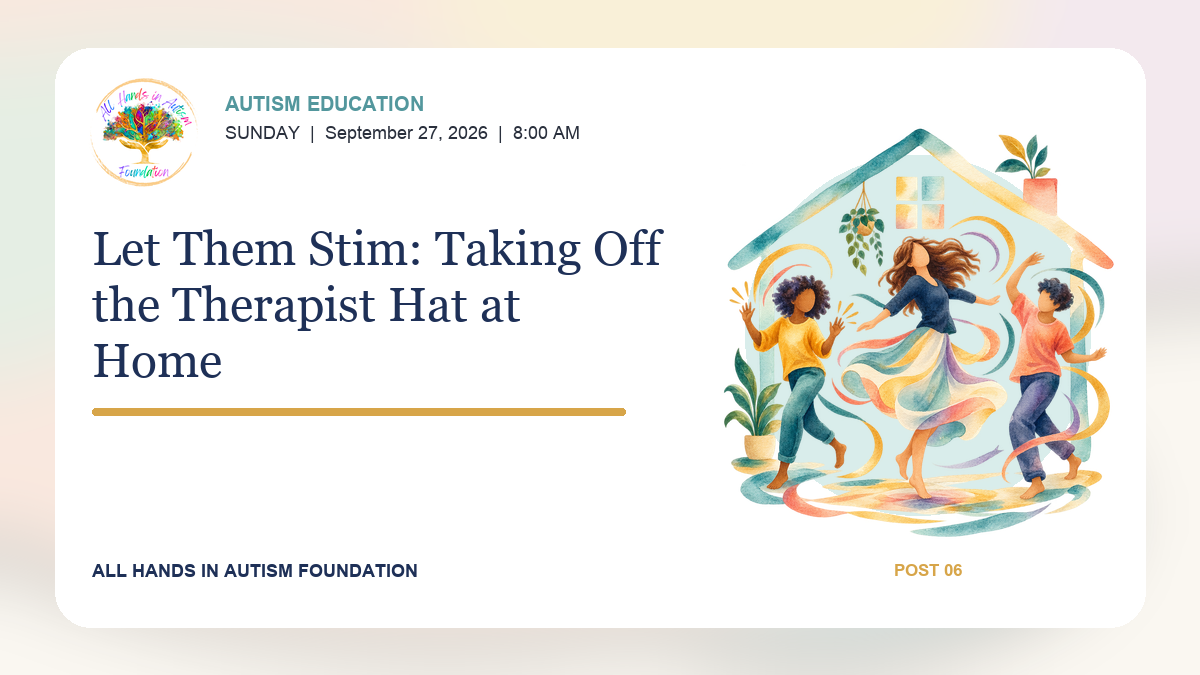
A child starts spinning during a game, and the caregiver brain immediately begins taking notes: Could this become a motor goal? Should we add language? Can we turn it into a turn-taking exercise?
Then comes the quiet realization: We were just playing.
When families spend hours in evaluations, therapy, school meetings, home programs, and progress reviews, it is easy to start viewing every moment through a treatment lens.
You are allowed to take off the therapist hat. Your child is allowed to flap, pace, rock, hum, repeat, spin, line things up, or enjoy movement without every moment becoming a lesson.
What Stimming Can Do
“Stimming” commonly refers to repetitive movements, sounds, or behaviors. Different people stim in different ways, and the same behavior may serve different purposes at different times.
VERIFIED FACT: In a qualitative study of 32 adults with autism, participants described stimming as a way to regulate overwhelming sensations or emotions and, at times, communicate intense feelings. Participants also described the harm of being judged or pressured to stop.
That study reflects adult experiences and does not explain every child’s behavior. It does offer an important correction to a common assumption: a repetitive movement is not automatically meaningless or something that must be eliminated.
Stimming may be connected with:
- Sensory regulation
- Excitement or joy
- Anxiety or uncertainty
- Concentration
- Communication
- Predictability
- Releasing built-up energy
- Enjoying a sound, movement, or visual pattern
Instead of beginning with “How do we stop this?” try beginning with “What might this be doing for this person?”
Support Safety, Not Sameness
Acceptance does not mean ignoring danger, pain, or serious interference with daily life.
If a behavior causes injury, prevents sleep, creates a choking risk, damages hearing, or makes essential activities impossible, the goal can be to understand the need and find a safer option—not to punish difference.
For example:
- Head hitting may require medical evaluation, pain assessment, environmental changes, communication support, and safer regulation tools.
- Chewing unsafe objects may require a feeding, dental, medical, or occupational-therapy assessment and safer alternatives.
- Loud vocalizing in a setting where hearing safety matters may call for a quieter space or another way to release the same energy.
- Pacing in a dangerous area may call for a protected movement route rather than forced stillness.
A useful question is: Can the need be honored in a safer way?
Let Home Be Home
Children with autism often work hard in environments built around schedules, expectations, transitions, social rules, and adult-led tasks. Home can be one place where the pressure to perform is lower.
Try creating “no-goal play”:
- Follow the child’s lead for ten minutes.
- Do not quiz, prompt, or test.
- Join the pattern if invited.
- Describe joy rather than measuring progress.
- Allow movement while listening.
- Let toys be used in unconventional but safe ways.
- Notice connection that does not require eye contact or spoken language.
Taking off the therapist hat does not mean rejecting helpful services. It means remembering that the parent-child relationship is not a treatment plan.
A child can receive support and still deserve spaces where nothing about them is being scored.
Watch Your Language
The words adults use can shape how a child understands themselves.
Instead of:
- “Stop doing that.”
- “Hands quiet.”
- “You are being weird.”
- “Use your body normally.”
Try:
- “Your body needs movement.”
- “You look excited.”
- “Let’s find a safe space to spin.”
- “That sound is too loud for this room; where can we do it safely?”
- “Do you want your headphones, a break, or more space?”
This language protects dignity while still setting necessary boundaries.
It is also worth noticing whether adults are more uncomfortable with the appearance of a stim than the person is with the experience. A behavior can attract attention and still be harmless. Acceptance often begins when we separate genuine risk from pressure to look typical in public.
A Home Acceptance Checklist
- Notice when and where the behavior occurs.
- Consider sensory, emotional, communication, medical, and environmental factors.
- Avoid stopping harmless stimming simply to make a person appear more typical.
- Intervene when there is a genuine safety, health, consent, or access concern.
- Offer safer alternatives without shame.
- Ask the person with autism about the behavior whenever they can communicate their perspective.
- Give siblings simple, respectful language about different ways bodies regulate.
- Keep at least one part of the day free from therapy-style demands.
One action for this week: Choose one safe, harmless stim you will simply observe without correcting.
A Place for Joy, Not Fixing
All Hands in Autism Foundation believes people with autism deserve support that protects dignity, communication, access, and authentic joy.
The Foundation’s future spaces and community programs should be designed with room for movement, sensory choice, connection, and unstructured play—not around the idea that every difference needs to be fixed.
Parents can support growth without turning every interaction into work. Sometimes the most meaningful thing you can do is sit nearby, follow the rhythm, and enjoy your child exactly as they are in that moment.