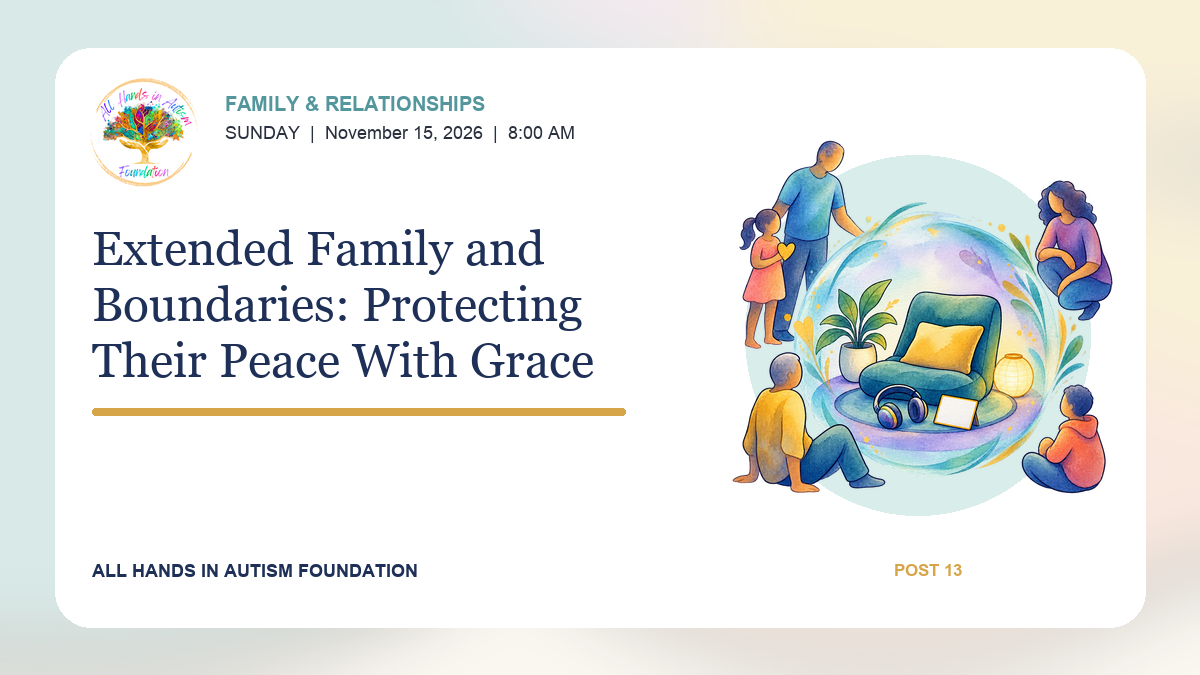
Most families have at least one well-meaning relative who believes the answer to every challenge is “more discipline.”
They may question headphones, insist on a hug, comment on food, criticize a child for leaving the room, or announce that “children have to learn” while the caregiver is trying to prevent overload.
You are allowed to appreciate a relative’s intentions and still reject advice that does not protect your child. Kindness does not require unlimited access to your child’s body, nervous system, medical information, or dignity.
Judgment Is Not Harmless
VERIFIED FACT: Research on parents’ experiences of community and professional attitudes toward autism has documented both accommodation and prejudice. Other studies have linked autism-related stigma experienced by parents with greater stress and poorer family well-being.
Those findings do not prove that every difficult family comment causes lasting harm. They do show why repeated judgment deserves attention.
A child may hear more than adults realize. Siblings hear it, too. When support needs are described as bad behavior, manipulation, laziness, or poor parenting, the message can settle into the whole family.
Boundaries interrupt that message.
Decide the Boundary Before the Gathering
A boundary is not an attempt to control another person’s opinion. It is a statement about what you will allow, participate in, or do next.
Examples:
- “We do not force hugs. You can offer a wave, high-five, or hello.”
- “Headphones help with access. They are not up for debate.”
- “Please do not comment on what is on the plate.”
- “We do not discuss the diagnosis in front of the children.”
- “If the room becomes too loud, we will take a break.”
- “If the discipline comments continue, we will leave.”
- “We are following our child’s support plan and will not argue about it today.”
Say it briefly. Long explanations often create more openings for debate.
You do not have to present a research seminar before protecting your child.
Use the Boundary Ladder
Not every situation requires the strongest response first. A boundary ladder gives you options.
Step 1: Redirect
“Let’s change the subject.”
Step 2: Clarify
“That comment treats a support need like a character problem. Please stop.”
Step 3: Set the consequence
“If the comments continue, we will take the children home.”
Step 4: Follow through
Leave, end the call, move to another room, or pause future gatherings.
The follow-through is what turns a request into a boundary.
If a relative apologizes and changes, allow room for repair. If they repeatedly ignore the limit, protecting peace may require less contact, shorter visits, neutral locations, or separate celebrations.
Protect Consent and Communication
Family affection should never require forced physical contact.
Offer choices:
- Hug
- High-five
- Fist bump
- Wave
- Verbal greeting
- AAC greeting
- No greeting yet
A child who does not speak, make eye contact, sit at the table, or respond immediately is not being disrespectful. Communication and regulation can look different.
Relatives can be taught to connect through the child’s interests, parallel play, shared activities, or quiet presence rather than demanding a conventional social performance.
Prepare a Calm Space and Exit
Before arriving, identify:
- A quieter room or outdoor space
- Where sensory tools will be kept
- Which adult will respond to comments
- A transportation plan
- A code word between caregivers
- The earliest acceptable departure time
- Which traditions are optional
Tell the host what will help before the event. A supportive relative may lower music, reserve a room, serve a safe food, or explain the plan to others.
If the host refuses every accommodation, that information can guide whether attending is healthy for your family.
Boundary Scripts for Common Comments
“He just needs discipline.” “He needs support that matches how he communicates and regulates. We are not discussing discipline.”
“She has to eat what everyone else eats.” “We are keeping food low-pressure and safe. Please do not comment on her plate.”
“He doesn’t look like he has autism.” “Autism does not have one appearance. We are not evaluating his diagnosis at dinner.”
“She should hug Grandma.” “She decides what happens to her body. You can offer another greeting.”
“You are letting him get away with it.” “We are responding to a support need. This conversation is over.”
Family-Gathering Checklist
- Choose the nonnegotiable boundaries.
- Tell the host in advance.
- Pack communication and sensory supports.
- Bring a safe food if needed.
- Protect body autonomy.
- Keep explanations short.
- Leave when the environment is no longer workable.
- Debrief with children without blaming them.
- Thank relatives who made access easier.
One action for this week: Write one sentence you will use the next time someone mistakes a support need for poor discipline.
Supportive Community Matters
All Hands in Autism Foundation wants families to have spaces where they do not have to defend every accommodation.
The Foundation community cannot replace every family relationship, and we will not claim that it does. It can offer another circle of understanding, practical ideas, and people who recognize the courage it takes to set a graceful, firm boundary.
Protecting your child’s peace may disappoint someone. That is different from doing something wrong.