There are parents who know sports statistics. There are parents who know recipes.
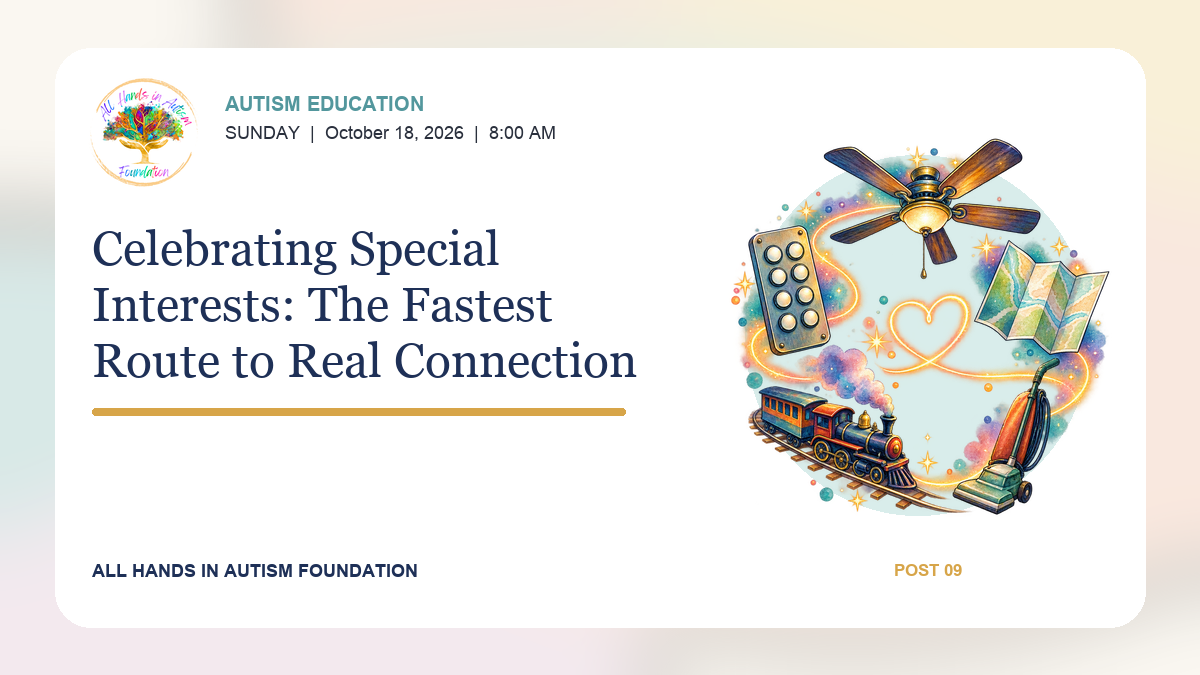
Then there are parents who can identify a ceiling fan by blade pitch, explain which elevator has the most satisfying door sound, or discuss a 1997 vacuum-cleaner attachment with surprising authority.
If your household has become an unofficial museum for one highly specific subject, welcome. You are not “feeding an obsession” simply because you are interested in what brings your child alive.
Special Interests Are More Than Trivia
A special interest may be broad, such as animals, music, or transportation. It may also be wonderfully specific: exit signs, washing machines, maps, calendar dates, weather alerts, logos, bottle caps, or one scene from one movie.
These interests can provide:
- Predictability
- Pleasure
- A sense of competence
- A way to organize information
- A conversation bridge
- Motivation for learning
- Recovery after a demanding day
- Connection with people who share the interest
VERIFIED FACT: A study of adults with autism found that motivation to engage in special interests was associated with greater subjective well-being and satisfaction in areas including leisure and social contact. The study involved adults, so it should not be used to promise the same outcome for every child. It does support listening to people with autism who describe special interests as meaningful parts of life.
The question is not only, “How can we use this interest to make the child do something else?” It is also, “How can we honor something that matters to this person?”
Join Before You Redirect
Adults sometimes approach a special interest only as a teaching tool:
- “You can talk about trains after homework.”
- “Use the dinosaur to practice eye contact.”
- “Earn five minutes of fan videos.”
- “Let’s turn every elevator ride into a speech exercise.”
Motivation can be helpful, but an interest loses some of its joy if it is always held behind a demand.
Try joining first:
- Ask what the child notices that you do not.
- Let them teach without correcting the presentation.
- Watch the favorite clip.
- Visit a safe place connected with the interest.
- Find a book, model, documentary, or community group.
- Draw, build, sort, photograph, or map together.
- Use the person’s preferred communication method.
Connection may look like shared attention without a long conversation. It may be sitting beside someone while they line up models or repeat a favorite fact. That still counts.
Use the Interest Without Taking It Over
Special interests can naturally support learning when the connection feels respectful.
A fan interest might lead to:
- Counting blades
- Learning about electricity and safety
- Drawing shapes
- Comparing speeds
- Photographing architecture
- Writing labels
- Practicing a store interaction
A map interest might support reading, planning, distance, geography, or preparation for transitions.
The difference is tone. The interest should remain something the person owns—not a tool adults confiscate and reissue as therapy.
Ask, “Would you like to use your interest for this?” rather than assuming permission.
Balance Without Shame
Celebration does not mean there are never limits. Any activity may need boundaries when it affects sleep, health, safety, consent, school access, or another family member’s ability to function.
Reasonable boundaries sound like:
- “We can watch two videos, then the tablet charges overnight.”
- “You may talk about this, and your sister gets a turn to choose the topic.”
- “That machine is not safe to touch, but we can take a photo from here.”
- “We cannot buy every model, so let’s make a wish list.”
- “You can bring the map; we still need to leave at 4:00.”
Boundaries do not require mocking the interest or calling it weird. They simply make room for the whole family.
It is also helpful to watch for distress. If the person cannot access basic needs, becomes panicked by any interruption, or is losing sleep or daily functioning, discuss the pattern with an appropriate professional while preserving respect for the interest itself.
Create a Special-Interest Connection Plan
- Write down the current interest without judgment.
- Ask the person what they love most about it.
- Choose one way to join this week.
- Find one safe resource that goes deeper.
- Identify any necessary family boundary.
- Make sure the interest is not always used as a reward.
- Look for a chance to share expertise with someone who genuinely wants to listen.
- Protect unstructured time for enjoyment.
One action for this week: Ask one sincere question about the detail your child cares about most.
Let Joy Be Valuable on Its Own
All Hands in Autism Foundation believes support should build access and possibility without erasing what makes a person light up.
Special interests can open doors to friendship, education, future work, self-knowledge, or simply a peaceful afternoon. Not every interest has to become a career or developmental goal to be worthwhile.
Share the ceiling-fan model. Show us the elevator button collection. Tell us which vacuum had the best attachments. In the All Hands community, wonderfully specific joy is welcome.